The Human Alignment System · Organizations

Scale with clarity.
Change with alignment.

Connect strategy, decisions, capacity, and communication so people across functions, locations, and levels can act toward shared outcomes.

As we grow and change, do people understand what matters, have the capacity to act, and know how to resolve competing demands?

Four connected organizational practices

Make alignment work
across the organization.

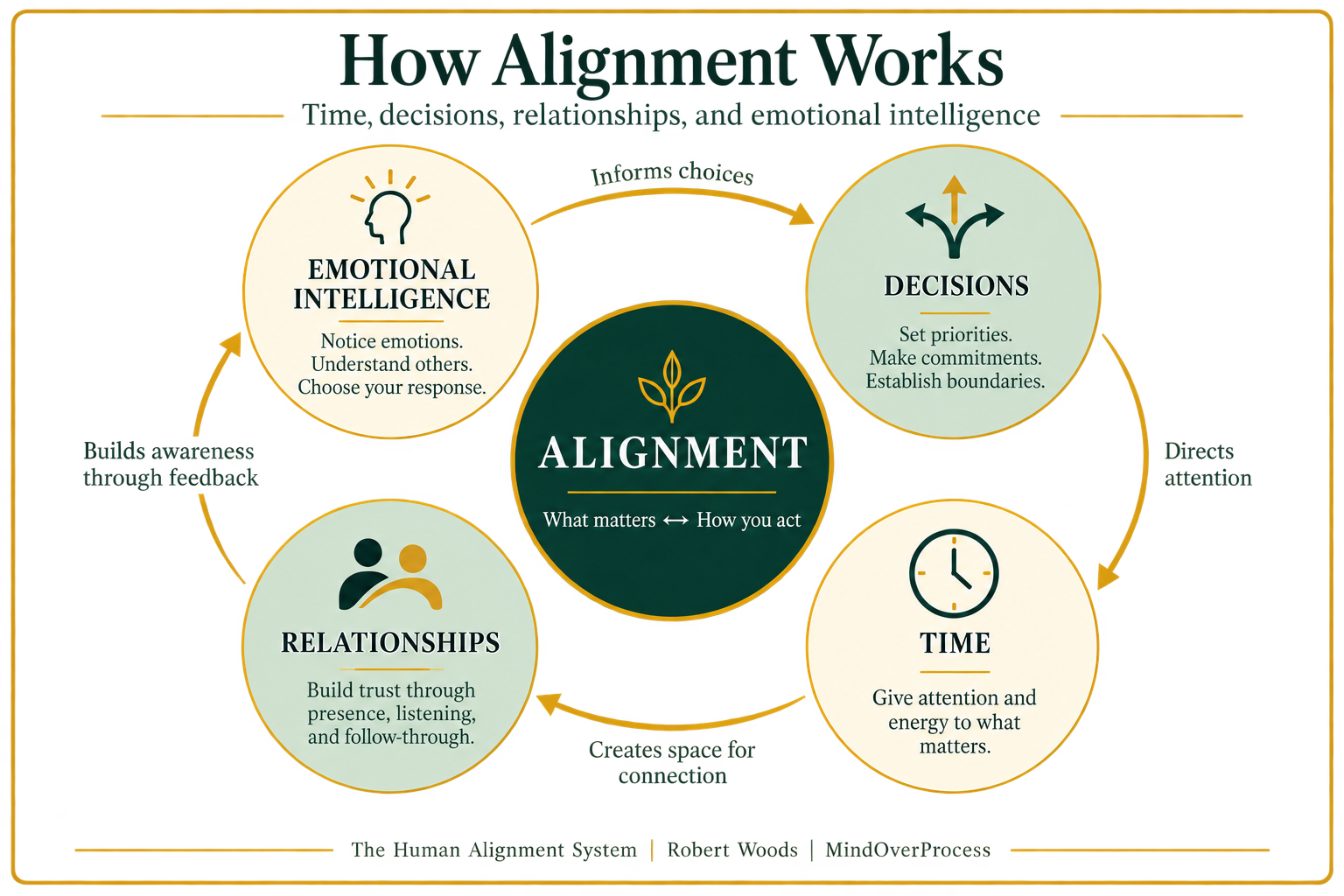
The same four-part model extends beyond individual leaders to the decisions, working relationships, and routines that connect an enterprise. Apply it through concrete practices at each level.

Alignment cycle: emotional intelligence informs decisions; decisions direct time; time creates space for relationships; relationships build awareness through feedback.
View the diagram full size (opens a new tab)

01 · Emotional intelligence

Understand the experience of change.

Listen to how different groups experience uncertainty, workload, and changing roles. Equip managers to respond with empathy and invite concerns without penalty.

Ask: “What are people worried about, and what support is missing?”

Organizational practice: Gather feedback by role and location, share themes responsibly, and distinguish misunderstanding from practical barriers or valid objections.

02 · Decisions

Connect strategy to local choices.

Translate enterprise outcomes into portfolio priorities and team decisions. Make authority explicit so growth does not send every question back to the executive team.

Ask: “What is consistent everywhere, what can be adapted locally, and who decides?”

Organizational practice: Define decision ownership, common guardrails, local discretion, and escalation paths across functions.

03 · Time

Plan for delivery and adoption.

Make operational work, strategic initiatives, training, and transition demands visible together. Sequence change against the capacity of the people affected.

Ask: “Can the impacted teams absorb this change while meeting current obligations?”

Organizational practice: Use one view of major commitments, dependencies, and change impacts to decide what starts, stops, or moves.

04 · Relationships

Make communication a shared responsibility.

Connect sponsors, managers, delivery teams, and frontline employees through clear handoffs and two-way communication. Close the loop on questions and concerns.

Ask: “Who needs to understand or do something differently, and how will we know they can?”

Organizational practice: Agree message owners, channels, feedback routes, and response responsibilities across organizational boundaries.
Benefits to work toward

Growth people can support.
Change they can put into practice.

The engagement aims to improve coordination and adoption as complexity increases. Outcomes depend on the organization’s constraints, leadership follow-through, and the changes being introduced.

Clearer decisions at scale

Teams know when to act locally and when to escalate, reducing unnecessary waits and inconsistent choices.

More manageable change

Sequencing and explicit capacity commitments make competing change demands visible before rollout.

More useful communication

People understand why the change matters, what it means for their role, and where to get help.

More consistent execution

Common outcomes and clearer handoffs connect local work to enterprise priorities while allowing appropriate adaptation.

Three areas of focus

Design the conditions
for change to work.

Organizational scaling

Keep decisions close to the work.

  • Define enterprise outcomes and the measures teams share.
  • Identify standards required for consistency, quality, or obligations.
  • Specify where regions and functions may adapt their approach.
  • Map dependencies and the owners of cross-team handoffs.
  • Review bottlenecks as scope and volume increase.

Output: A decision and dependency map with common guardrails and local authority.

Change management

Make adoption achievable.

  • Map affected roles and the behaviors that will change.
  • Assess readiness and overlapping change demands.
  • Clarify sponsor and manager responsibilities.
  • Provide practice, training, job aids, and support.
  • Pilot, learn, and agree readiness criteria before expansion.

Output: A change impact and adoption plan, including support and reinforcement.

Communications

Turn messages into understanding.

  • Maintain a shared explanation of why, what, when, and impact.
  • Tailor the message to each audience’s decisions and actions.
  • Equip managers to explain the change in team conversations.
  • Provide accessible channels and a clear feedback owner.
  • Check understanding and publish answers or adjustments.

Output: An audience-based communication plan with a feedback loop.

A potential facilitated exercise · 3 hours

Align one change
before scaling it.

Bring an executive sponsor, functional and regional leaders, change and communication owners, and representatives of the affected work. Use one real cross-functional change as the focus.

Before the workshop

Gather current priorities, decision bottlenecks, capacity commitments, stakeholder feedback, and available performance data. Speak with affected employees as well as leaders. Agree the workshop’s scope and who can authorize decisions.

Illustrative scenario: A growing organization wants to introduce a shared customer onboarding process across three regions. Each region has different handoffs, systems, customer needs, and competing initiatives. The exercise creates a pilot agreement and a path toward wider adoption.

  1. 20 minutes

    Agree on the outcome and constraints

    Define the customer and organizational problem. Hear different regional perspectives, identify non-negotiable obligations, and select a shared outcome.

    Output: An outcome statement, scope boundaries, sponsor, and baseline data owner.

  2. 30 minutes

    Map decisions and dependencies

    Trace the work across functions and regions. Identify common standards, local adaptations, handoff owners, and the authority for resolving exceptions.

    Output: A decision-rights and dependency map, including unresolved issues requiring approval.

  3. 30 minutes

    Assess change impact and capacity

    Identify which roles must work differently, what they need to learn, and where other changes compete for their time. Choose a feasible pilot and explicitly adjust commitments.

    Output: A role-based impact map, capacity allocation, stop/defer list, and initial readiness criteria.

  4. 10 minutes

    Pause and reflect

    Take a break. Invite participants to note concerns or assumptions that still need discussion before commitments are finalized.

    Output: A short list of outstanding questions for the remaining session.

  5. 30 minutes

    Design communication and feedback

    Agree the shared change message. For each audience, name the messenger, channel, timing, required action, and route for questions. Decide how answers and adjustments will be communicated back.

    Output: An audience-based communication plan and an owned feedback process.

  6. 30 minutes

    Plan the pilot and adoption support

    Assign training, practice, job aids, manager support, and issue resolution. Define evidence required to expand the pilot and the conditions for pausing or revising it.

    Output: A pilot plan with support owners and a scale, adjust, or pause decision gate.

  7. 30 minutes

    Commit to the first 30 days

    Assign action owners, due dates, and measures. Schedule weekly coordination and a 30-day sponsor review. Read back decisions and confirm which still need authorization.

    Output: A 30-day action plan, decision log, review schedule, and shared leadership message.

Specific outcomes for the organization

Leave with agreements.
Track what changes.

The workshop produces plans and decisions. Operational benefits are assessed during implementation. Sample targets below are illustrative and must be agreed against actual baselines and constraints.

Example outputs and measures for a regional onboarding rollout
OutputPotential agreementMeasure and owner
Shared business outcomePropose reducing median onboarding time from a verified 20-day baseline to 15 days within 90 days, without increasing rework.Operations reports time and rework by region; the sponsor confirms the target after baseline review.
Decision authority at scaleUse one set of required handoffs; let regions adapt meeting schedules and customer communications within agreed standards.Process owner tracks exception age, escalations, and unclear ownership each week.
Capacity and sequencingPilot in one region before expansion; reserve named delivery and training capacity and defer conflicting work where authorized.Portfolio lead reviews committed versus available capacity and overlapping changes by affected team.
Change readiness and adoptionBefore expansion, propose that 90% of pilot users can complete the required workflow in a role-based practice check, with no unresolved critical issues.Change lead reports demonstrated proficiency and actual workflow use. Training attendance alone does not establish adoption.
Communication and understandingManagers explain the change before launch. Propose that 85% of sampled affected employees can explain what changes for their role and where to get help.Communication lead checks understanding across roles and regions; logs questions and closes the loop on responses.
Trust and feedbackProvide team discussions and a private route for concerns. Assign an owner to each issue and communicate the response or next update date.Change lead reviews issue age, response completion, and recurring themes, using aggregated feedback for reporting.
Accountability and learningEvery action has an owner and date. The sponsor reviews evidence before deciding to scale, adjust, or pause.Program lead maintains the action and decision logs and prepares the day-30 review.

From workshop to sustained alignment

A practical 30 / 60 / 90-day path.

Days 1–30 · Establish and prepare

Confirm baselines, decision ownership, pilot scope, capacity, role impacts, and communication responsibilities. Prepare managers and participants.

Days 31–60 · Pilot and learn

Run the pilot, support new behaviors, review feedback and performance, and resolve friction. Compare evidence with agreed readiness criteria.

Days 61–90 · Expand or adjust

Extend the approach where evidence supports it. Adapt local implementation, reinforce learning, and review business outcomes alongside adoption.

Organizational Alignment with Robert Woods

Connect your strategy
to how people work.

Discuss a scaling challenge, enterprise change, or communication gap. Robert brings more than 20 years of transformation and leadership advisory experience, emotional intelligence coaching, and the CLEAR principles for organizational resilience.

Discuss an organizational alignment session

Email robert@alignsystemsgroup.com. Scope and fees are agreed before an engagement begins.

Explore Leadership Team Alignment