The Human Alignment System · Leadership teams

Shared priorities.
Aligned leadership.

Bring your decisions, calendars, capacity, and leadership behaviors into line with the outcomes your team wants to achieve.

Do our everyday choices support the priorities we say matter most?

Four connected leadership practices

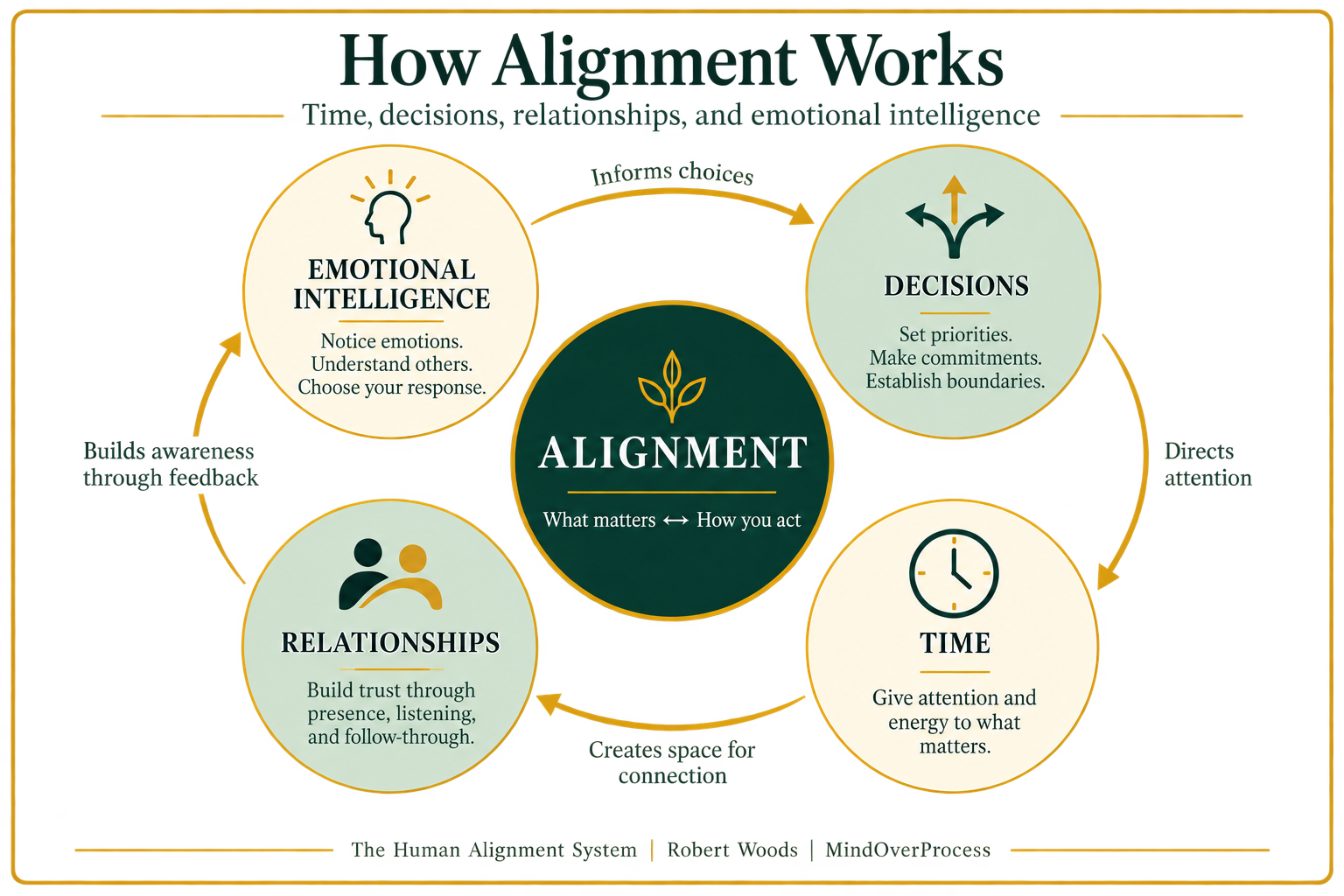
How alignment works
across a team.

Emotional awareness informs decisions. Decisions direct time and attention. Time invested in relationships builds trust and feedback that strengthen awareness.

Alignment cycle: emotional intelligence informs decisions; decisions direct time; time creates space for relationships; relationships build awareness through feedback.
View the diagram full size (opens a new tab)

01 · Emotional intelligence

Make pressure discussable.

Notice how urgency, defensiveness, and competing interests affect the conversation. Invite disagreement and listen before responding.

Ask: “What concern or assumption is influencing my position?”

Team practice: Each leader names a concern; another summarizes it before the team discusses a response.

02 · Decisions

Turn agreement into choices.

Define shared outcomes, decision authority, and the trade-offs required to deliver. Record how exceptions will be handled.

Ask: “Who decides, using which criteria, and what will we stop or defer?”

Team practice: Keep a decision log with an owner, rationale, deadline, and review point.

03 · Time

Give priorities real capacity.

Compare strategic commitments with calendars, meeting agendas, and available people. Account for mandatory work and existing constraints.

Ask: “Where will the time come from, and what must move?”

Team practice: Protect capacity for the priority and explicitly renegotiate conflicting commitments.

04 · Relationships

Build trust across functions.

Address disagreements directly, clarify handoffs, and communicate decisions consistently. Make it safe to flag a commitment at risk.

Ask: “What do you need from my function to keep our shared commitment?”

Team practice: Agree on handoff owners, escalation timing, and how to repair missed commitments.
Benefits to work toward

Less ambiguity.
More deliberate action.

The aim is a team that can act consistently, surface conflicts early, and adjust together. Results depend on follow-through and the team’s circumstances.

Clearer focus

Leaders can explain the same priorities and connect departmental choices to them.

More timely decisions

Explicit authority and criteria reduce unnecessary escalation and repeated debate.

More realistic commitments

Capacity checks expose overload before new promises are made.

Stronger accountability

Visible owners and direct conversations make dependencies and missed commitments easier to address.

A potential facilitated exercise · 90 minutes

One priority.
One team agreement.

Designed for a leadership team of roughly 4–8 people. Work through one shared priority and leave with decisions, owners, and a review date.

Before the session

Each leader independently identifies their top three priorities, major commitments, one capacity constraint, and one unresolved dependency. Bring relevant meeting calendars and an initiative list. The facilitator compares perspectives and shares themes without attributing sensitive comments without permission.

Illustrative scenario: Customer onboarding is the stated priority, but Sales promises custom features, Product pursues new functionality, and Operations absorbs exceptions. The team must agree how to support a consistent onboarding experience.

  1. 15 minutes

    Surface the different perspectives

    Compare individual priorities. Each leader shares one concern; another reflects it back before offering a solution. Identify the competing assumptions.

    Output: A shared problem statement and a list of the main tensions to resolve.

  2. 20 minutes

    Choose an outcome and decision rules

    Define what customers should experience, select a measure, and appoint the accountable sponsor. Agree who can approve onboarding exceptions and under what conditions.

    Output: One agreed outcome, its owner, a measure, and an exception decision rule.

  3. 20 minutes

    Reconcile commitments with capacity

    Identify the work and people the outcome requires. Choose what to stop, defer, delegate, or renegotiate. Record constraints that need approval outside the room.

    Output: A capacity commitment and a stop/defer list with accountable owners.

  4. 20 minutes

    Agree how leaders will work together

    Clarify cross-functional handoffs, how disagreements will be resolved, and when risks must be raised. Draft the same message for each leader to share with their team.

    Output: Three leadership working agreements and a shared communication message.

  5. 15 minutes

    Commit and schedule the review

    Each leader names one action, owner, and due date. Set a first-week check and a 30-day review. Identify who will collect the baseline and progress data.

    Output: A 30-day action plan with named owners, dates, and measures.

What the team leaves with

A concrete alignment agreement.

This example illustrates the decisions the exercise can produce. Figures below are sample targets to adapt after checking the baseline, capacity, and business context.

Example outputs for the customer onboarding scenario
Team outputExample agreementHow the team checks it
Shared outcomeReduce median onboarding time from a verified 20-day baseline to a proposed 15 days within 90 days, while maintaining service quality.Operations tracks elapsed time and rework weekly; the team confirms the target after baseline review.
Decision ownershipAn appointed onboarding sponsor decides exception requests with input from Sales, Product, and Operations within two working days.Record the request date, decision, owner, and rationale in the decision log.
Capacity and trade-offsAssign named cross-functional capacity and defer two lower-priority enhancements for 30 days, subject to existing obligations.Review committed versus available capacity and new competing requests each week.
Working agreementsRaise blocked handoffs within one working day; challenge decisions directly; communicate the agreed decision consistently.Review aged blockers and ask each leader where an agreement helped or broke down.
AccountabilityEvery action has one owner and a due date. Hold a 20-minute weekly review and a fuller review on day 30.Track on-time actions, unresolved dependencies, and progress toward the customer outcome.

Leadership Team Alignment with Robert Woods

Start with a priority
your team needs to share.

Bring a real decision, competing commitment, or cross-functional challenge. Together, we can discuss a session shaped around your leadership team and the outcomes you need.

Discuss a leadership alignment session

Email robert@alignsystemsgroup.com. Scope and fees are agreed before an engagement begins.

Explore other ways to work together